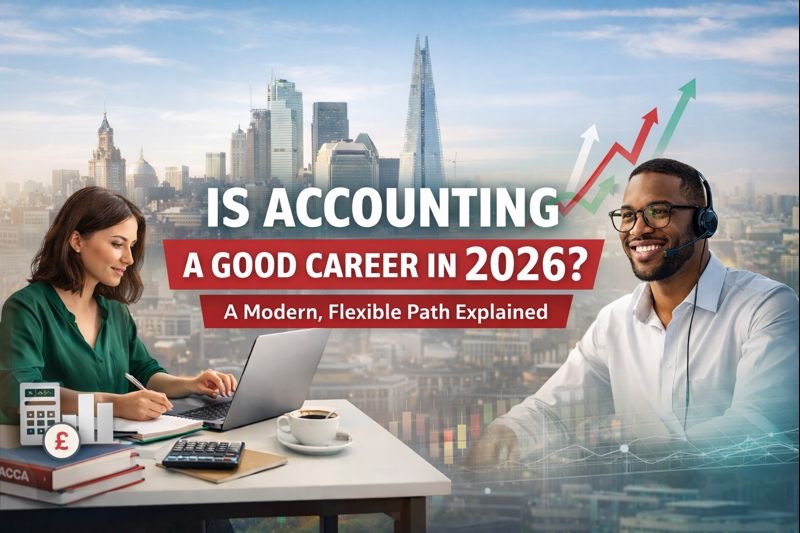
Is accounting a good career in 2026? The answer looks very different from what most people expect, as modern accounting has evolved into a flexible, globally relevant profession.
Accounting has changed dramatically over the last decade. What was once seen as a rigid, office-bound profession is now one of the most flexible and globally relevant career paths available.
So if you’re asking “Is accounting still a good career in 2026?” the short answer is: yes — but not for the reasons you might think.
This guide breaks down what modern accounting careers actually look like, who they’re suited to, and how flexible qualifications can fit around real life.
Accounting Careers Have Evolved (A Lot)
Forget the outdated stereotype of spreadsheets and silent offices.
Modern accounting is increasingly shaped by:
- Cloud accounting software
- Automation and AI tools
- Remote and hybrid working
International clients and cross-border finance Technology now handles much of the repetitive work. What matters more are problem-solving, understanding data, and advising businesses.
That’s why accounting is no longer just about “being good at maths”. It’s about clarity, structure, and decision-making.
Why Accounting Is Still a Strong Career Choice
Accounting remains one of the most stable and transferable career options available.
Key reasons people choose accounting today:
Skills that are recognised internationally
Clear progression routes
Opportunities across industries
Options to work freelance, employed, or remotely
For many, it’s also a career that grows with you. Is accounting a good career in 2026 – You can start small, study alongside work, and build confidence step by step.
Who Is Accounting Actually For?
One of the biggest misconceptions is that accounting is only for school leavers or finance graduates.
In reality, modern accounting qualifications are popular with:
Career changers looking for stability
People returning to work after time out
Professionals wanting a recognised skillset
Learners who prefer structured, practical study
You don’t need to quit your job or start from zero. Many learners study part-time while testing whether accounting is the right fit for them.
Flexible Study Is the New Normal
Traditional education models don’t suit everyone anymore.
Accounting career 2026 courses are designed to be:
- Studied online or via live webinars
- Completed at your own pace
- Accessible from anywhere
- Affordable through monthly payment options
This flexibility is what makes accounting realistic for people with jobs, families, or other commitments. We offer a wide range of flexible study options.
Is Accounting a Good Career in 2026?
Automation hasn’t killed accounting — it’s reshaped it.
Businesses still need people who can:
- Interpret financial data
- Spot risks and opportunities
- Explain numbers clearly
Support growth decisions
Those skills aren’t going anywhere.
In fact, as systems become smarter, human judgement becomes more valuable, not less.
For many learners, Accounting Career 2026 offers a balance of stability, flexibility, and long-term relevance that few other paths can match.
Final Thoughts
So, Is Accounting a Good Career in 2026? Accounting is no longer about choosing a single, fixed path and sticking to it for life. It’s about building a skill set that gives you options.
For some, accounting becomes a long-term profession. For others, it’s a gateway into business, finance, consulting, or even entrepreneurship. The skills you gain don’t sit in isolation. They travel with you, across roles, industries, and even countries.
Independent industry bodies also support this shift. Organisations such as the Association of Chartered Certified Accountants regularly highlight how digital skills, flexibility, and strategic thinking are becoming central to modern finance roles, reinforcing that accounting careers are evolving rather than disappearing.
What makes accounting particularly relevant today is its flexibility. You can study alongside work. You can progress in stages. You can test whether it suits you before fully committing. That makes it one of the few careers that adapts to real life, rather than forcing life to adapt around it.
Technology will continue to change how accounting is done, but that isn’t a threat. It’s a shift. As systems automate more processes, the value moves towards people who understand the bigger picture, can interpret financial information, and can communicate it clearly.
If you’re looking for a career that offers structure without rigidity, stability without stagnation, and global relevance without being locked to one location, accounting remains a smart and realistic choice.