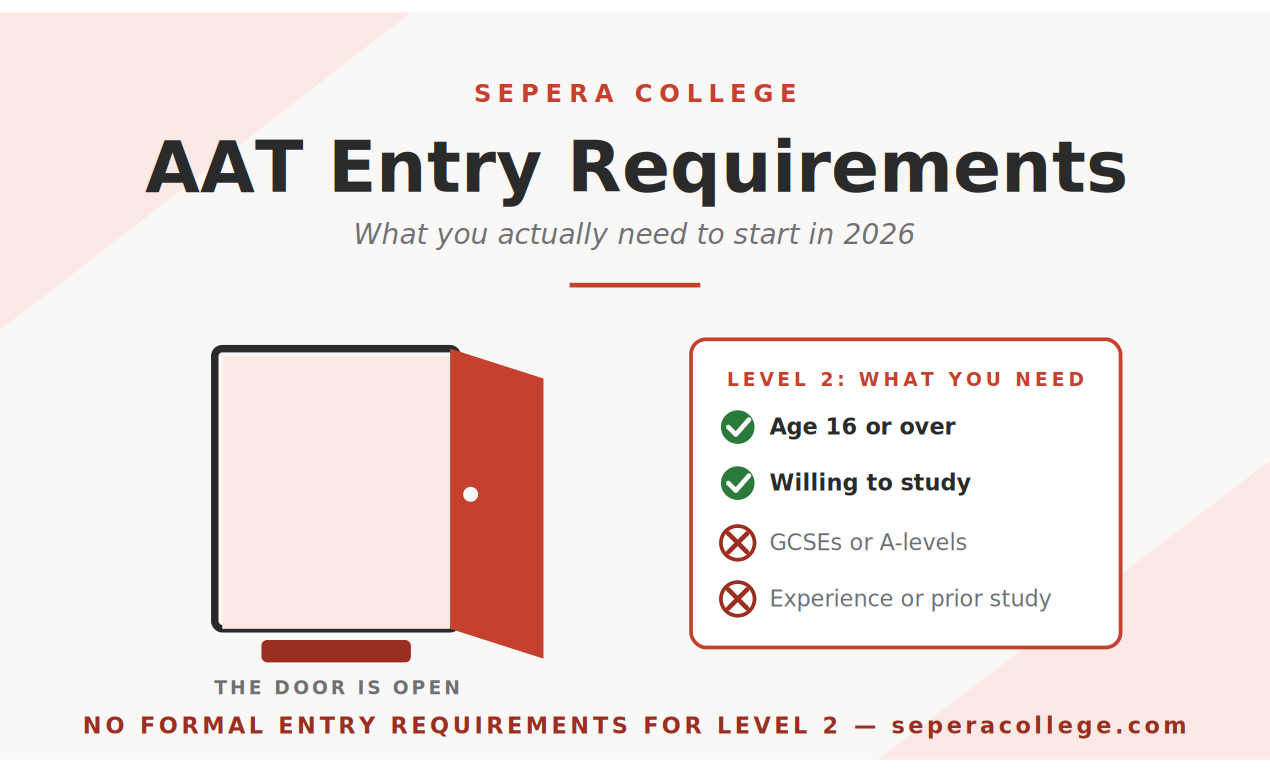
 AAT entry requirements stop more people starting an accounting career than the exams ever do. Prospective students assume they need GCSEs in maths, A-levels, prior office experience, or some formal qualification just to be allowed through the door, and they quietly rule themselves out before asking anyone. Here is the fact that surprises almost everyone: for AAT Level 2, there are no formal entry requirements at all.
This guide covers the real AAT entry requirements in 2026 at every level: what AAT actually asks for, what matters in practice even though nothing is formally required, how the AAT Skillcheck helps you pick the right starting level, and the specific situations (international students, returning learners, funded places) where a little extra preparation helps.
AAT entry requirements for Level 2: there are none
The Level 2 Certificate in Accounting and the Level 2 Certificate in Bookkeeping have no formal AAT entry requirements. No GCSEs. No A-levels. No previous accounting knowledge. No work experience. You need to be at least 16 years old, and that is essentially the list.
The absence of AAT entry requirements at this level is deliberate. AAT designed Level 2 as a genuine starting point for complete beginners, career changers, school leavers and returners to work. The qualification assumes nothing and builds everything from first principles, starting with what a debit and a credit actually are.
What helps in practice, even though the AAT entry requirements list nothing formally:
- Comfortable everyday maths. Percentages, ratios, multiplication and division. GCSE-grade comfort is plenty, and calculators are allowed in every assessment. You will never meet algebra beyond rearranging simple formulas.
- Functional written English. Course materials and exams are in English, and later levels include written tasks. You do not need to be a polished writer at Level 2.
- Basic computer confidence. Assessments are computer-based, and accounting work lives in software. If you can manage email, online banking and a spreadsheet, you are ready.
- Study time. The honest requirement nobody lists: a few protected hours per week, consistently. This matters more than any qualification you do or do not hold.
AAT entry requirements for Level 3
The Level 3 Diploma in Accounting also has no formal AAT entry requirements in the sense of certificates you must produce. In practice, you need the knowledge that Level 2 delivers, by whichever route you gained it:
- Completing AAT Level 2 is the standard route and the right one for most students.
- Relevant work experience can substitute. Bookkeepers, accounts assistants and finance administrators with solid double-entry knowledge often start directly at Level 3.
- Other accounting qualifications (A-level Accounting, certain bookkeeping certificates) can also provide the grounding.
The Level 3 AAT entry requirements are genuinely about knowledge rather than paperwork: if double-entry bookkeeping, basic costing and VAT fundamentals are comfortable, Level 3 is open to you. If they are shaky, starting at Level 3 to save time usually costs more time than it saves, because the Level 3 units assume that grounding from the first week.
AAT entry requirements for Level 4
The Level 4 Diploma in Professional Accounting expects Level 3 knowledge, and here the expectation is firm rather than soft. Level 4 units build directly on Level 3 financial statements and management accounting content. Students very occasionally start at Level 4 on the strength of degree-level accounting study or substantial professional experience, but for the overwhelming majority, completing Level 3 first is the entry route in practice, whatever the formal AAT entry requirements say.
The AAT Skillcheck: pick your level in 20 minutes
If the AAT entry requirements leave you unsure where to start, AAT provides a free online Skillcheck test that assesses your current knowledge and recommends a starting level. Two things worth knowing about it:
- It is a placement tool, not an exam. There is no pass or fail, no record, and no consequence beyond a recommendation. Take it cold; that is the point.
- A middling score is not a problem. Students regularly panic about scoring around 50% on prior knowledge. A score like that simply confirms Level 2 (or early Level 3) is the right starting point, which is exactly what the test is for. It means the course will teach you things you do not yet know, which is what you are paying for.
At Sepera College we look at Skillcheck results alongside your work background and goals before recommending a starting level, because the test measures knowledge but not context. A returner with rusty knowledge and ten years of finance admin behind them is a different Level 3 candidate from a school leaver with the same score.
AAT entry requirements for international students
AAT qualifications are open to international students, and the AAT entry requirements do not change by nationality. The practical additions:
- English language. There is no formal English test requirement for AAT itself, but study and assessment are entirely in English. As a working guide, if you can read this article comfortably, your English is sufficient for Level 2.
- Exams. Assessments are sat at approved venues or by remote invigilation. Students outside the UK, or in UK cities away from an exam centre, book through AAT-approved venues locally or sit remotely where available.
- Study mode. Online delivery removes geography entirely: Sepera College teaches students in the UK and internationally through the same online courses, with London and Manchester options for those who want in-person study.
What about funded places?
Meeting the AAT entry requirements is separate from meeting funding criteria. Jobseekers on Universal Credit exploring funded training through Jobcentre Plus should know the funding route has its own eligibility rules, set by the funding body rather than AAT, and the work coach conversation always comes first. Our free AAT courses guide explains that process step by step.
Common worries that are not actually barriers
The concerns we hear most at enrolment, none of which appear in any AAT entry requirements:
- “I failed GCSE maths.” Not a barrier under any AAT entry requirements. Level 2 teaches the numerical techniques it uses, and exam calculators remove the arithmetic pressure. Plenty of successful AAT students carry old maths anxiety in and leave it behind by the second unit.
- “I have been out of education for 20 years.” Not a barrier. Returners are one of the largest AAT student groups, and structured, modular study with clear assessments suits adults far better than school did.
- “I am too old to start.” There is a minimum age of 16 and no maximum. Career changers in their 40s and 50s complete AAT constantly.
- “I have no office experience.” Not required. Experience helps you apply the learning, but the qualification is designed to be completed before, during or after your first finance role.
- “English is not my first language.” Thousands of AAT students study in English as a second language. If your reading comprehension handles course materials, you are fine.
Frequently Asked Questions
What are the AAT entry requirements for Level 2?
There are no formal entry requirements. No GCSEs, no prior qualifications and no experience are needed. You must be at least 16 years old. Comfortable everyday maths, functional English and basic computer skills are helpful in practice.
Do I need GCSE maths to start AAT?
No. AAT has no GCSE requirements at any level. The maths involved is arithmetic, percentages and ratios, taught within the course, with calculators permitted in every assessment.
Can I skip Level 2 and start at Level 3?
Yes, if you already have Level 2-equivalent knowledge from work experience or another qualification. The AAT Skillcheck test helps confirm whether your double-entry and costing knowledge is genuinely ready. Starting at Level 3 without that grounding usually backfires.
Is there an age limit for AAT?
You must be at least 16. There is no upper age limit, and mature students and career changers make up a large share of every AAT cohort.
What score do I need on the AAT Skillcheck?
There is no pass mark; it is a placement tool, not an exam. A mid-range score simply indicates the level where teaching should begin, which is useful information rather than a problem. Discuss your result with your training provider before enrolling.
The only real requirement is starting
AAT entry requirements are the lowest barrier in professional accounting: 16 years old and willing to study. Everything else, the maths, the terminology, the software, the confidence, is built by the course itself. The people who never start are almost never excluded by the actual AAT entry requirements. They exclude themselves by assuming requirements that do not exist.
If you are weighing up where to begin, book a free consultation with Sepera College. We will review your background, interpret your Skillcheck result honestly, and recommend the right starting level for you, whether that is with us or not. For the official qualification details, see the AAT website.