 AAT distance learning is now how most people study AAT, but the question behind every enquiry is the same: does studying online actually work, or will I pay, drift, and quietly give up by unit three? It is the right question to ask, because the honest answer is: it works extremely well for some students, badly for others, and the difference is predictable in advance.
This guide explains how AAT distance learning works in 2026, the difference between self-paced study and live online webinars (they are not the same thing), how exams work when your course is online, whether employers see the qualification differently (they do not), and an honest checklist for whether distance study suits you.
First, the fact that settles the recognition worry
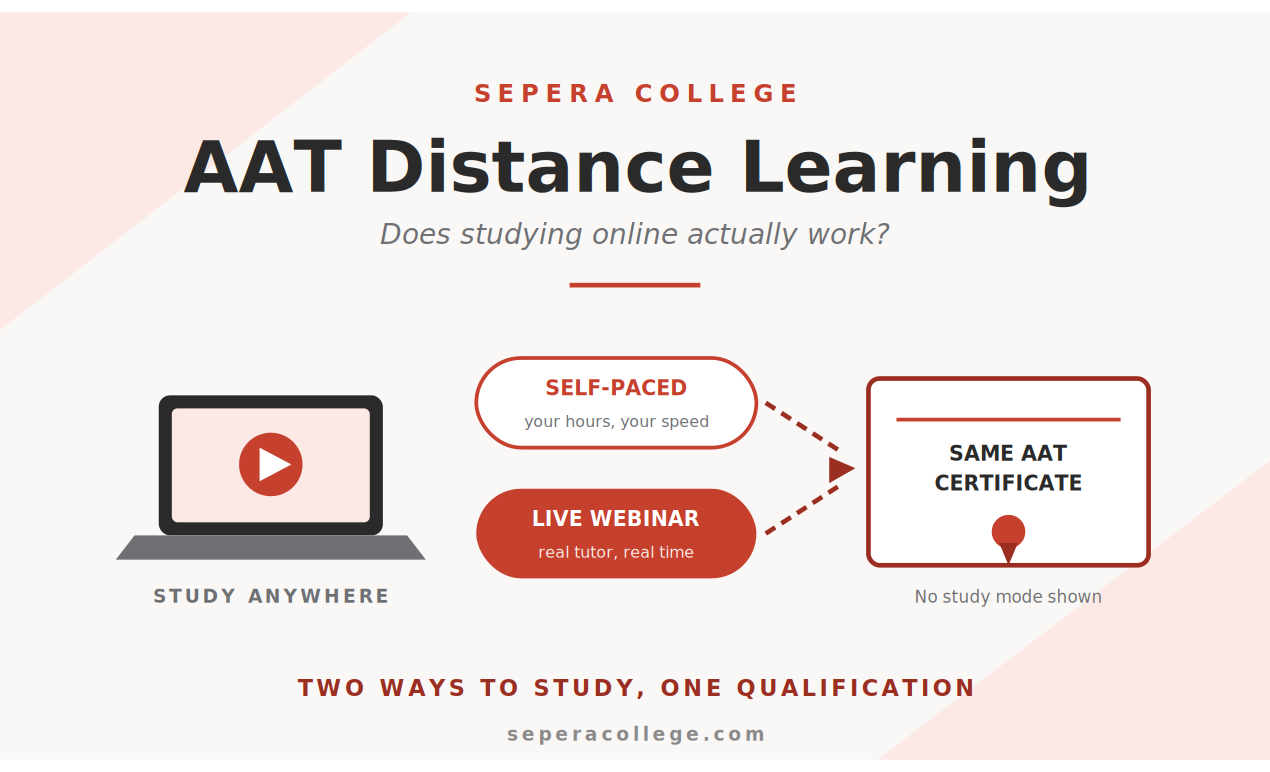
Start with the worry that hangs over every AAT distance learning enquiry. There is no such thing as an “online AAT qualification”. There is only the AAT qualification. Whether you study by distance learning, evening webinars or a college classroom, you sit exactly the same computer-based assessments, at the same pass mark, and receive exactly the same certificate with no mention of study mode anywhere on it. Employers cannot tell how you studied, and AAT does not distinguish. The recognition question, the one that stops many people enrolling, has a one-word answer: identical.
What AAT distance learning actually includes
A properly built AAT distance learning course is not a stack of PDFs. In 2026, good AAT distance learning should include:
- Structured video lessons following the official syllabus unit by unit, watchable on any device, at any hour, as many times as you need.
- Digital study materials and question banks mapped to the assessment style, because AAT exams reward practice far more than reading.
- Tutor support by email or messaging when you hit a wall. The speed and quality of this support is the biggest real difference between providers.
- Progress tracking and mock assessments so you know you are exam-ready before you spend money on a sitting.
- A study plan that turns “finish Level 2” into a week-by-week schedule, which matters more in distance study than anywhere else.
Self-paced online vs live webinar: the choice inside the choice
AAT distance learning splits into two genuinely different experiences, and choosing between them matters more than most students realise:
- Self-paced online study gives you total freedom: start any day, study at 6am or midnight, accelerate through familiar topics, linger on hard ones. It suits shift workers, parents with unpredictable days, fast movers, and anyone whose life refuses to follow a timetable. Its risk is drift: freedom includes the freedom to do nothing this week.
- Live online webinars add structure without adding a commute: scheduled sessions with a real tutor teaching in real time, questions answered on the spot, and a cohort moving together. It suits students who want accountability, immediate answers, and the feeling of a class, while keeping everything remote. Its constraint is the timetable: the sessions happen when they happen.
At Sepera College we deliver AAT through both routes, fully online self-paced study and live webinar courses, in English and Polish. Many students blend the decision by level: self-paced for Level 2 while testing their discipline, webinars for Level 3 when the content stiffens and the structure earns its keep.
How exams work for distance learners
The AAT distance learning course is online; the assessments are formal computer-based exams, and AAT distance learning students sit them in one of two ways:
- At an approved exam venue. Sepera College operates AAT exam centres in London (Ealing) and Manchester, and students elsewhere book at their nearest AAT-approved assessment venue. The exam is identical everywhere.
- By remote invigilation for eligible assessments, sat at home under webcam supervision with stricter rules (on-screen calculator only, digital scratch pad, a quiet cleared room).
Distance study therefore removes geography from the learning entirely and mostly removes it from the exams. A student in Cornwall, Warsaw or Dubai follows the same course as a student ten minutes from Ealing; only the exam booking differs.
The honest part: who AAT distance learning does not suit
The completion problem is real. The dropout risk in AAT distance learning does not come from course quality; it comes from the student-schedule fit. Be honest with yourself against this list:
- You need external deadlines to act. If nothing happens without a due date, pure self-paced study is dangerous. Choose the webinar route, where the timetable supplies the deadlines.
- Your motivation is social. If you learn through discussion and sink when alone, live webinar cohorts recreate most of that; silent self-study will not.
- You cannot protect study time at home. Distance learning happens where your family, flatmates and washing-up live. Without a defended weekly slot, the course loses to the house every time.
- You are avoiding the exam-booking decision. Distance students without a booked exam drift longest. The single best anti-drift device in AAT distance learning is a real exam date in the diary, booked when your mock scores justify it.
None of these is a character flaw, and none rules out AAT distance learning. They simply point you at the webinar version of it, or at building the structure yourself: fixed study evenings, a weekly target, and mock deadlines treated as real.
Choosing an AAT distance learning provider
The questions that actually separate AAT distance learning providers, ahead of price:
- Is it an AAT Approved training provider? Non-negotiable. Approval means the course is monitored against AAT’s standards.
- Who answers your questions, and how fast? Ask before enrolling. “Tutor support” ranges from next-hour replies from qualified accountants to a ticket queue.
- Are mocks and question practice included, or an upsell? Practice is where passes are built; it should not be an optional extra.
- Can you see the platform before paying? A provider confident in its course will show you inside it.
- Is there a bilingual option if you want one? Studying technical content in your strongest language, or with tutors who speak it, removes a quiet layer of friction. Sepera College teaches in English and Polish for exactly this reason.
On cost: AAT distance learning is consistently the most affordable route into the qualification, and self-paced courses cost less than webinar-supported ones. Current fees for each level and study mode are on our course pages, alongside instalment options. For what the overall qualification costs and earns back, our is AAT worth it breakdown covers the full picture, and our how long does AAT take guide helps you plan the timeline realistically around work.
Frequently Asked Questions
Is AAT distance learning recognised by employers?
Yes, identically to classroom study. The qualification, assessments, pass marks and certificate are the same regardless of study mode, and nothing on your certificate or AAT record indicates how you studied. Employers recognise the AAT qualification itself.
What is the difference between self-paced and webinar AAT courses?
Self-paced courses let you study any time at your own speed with tutor support when you ask for it. Webinar courses add scheduled live online classes with a tutor and cohort, providing structure and immediate answers. Both are distance learning; they differ in how much timetable they impose.
How do I sit exams if I study AAT online?
At any AAT-approved exam venue (Sepera College runs centres in London and Manchester), or by remote invigilation at home for eligible assessments. The assessments are identical to those sat by classroom students.
Can I do AAT distance learning while working full-time?
Yes; it is the standard pattern. Most distance learning students study around full-time work, typically committing six to ten hours a week. Self-paced study flexes around shifts; webinar courses suit stable schedules that can protect the session times.
Is AAT distance learning harder than classroom study?
The content and exams are identical. What differs is the discipline demand: distance learners supply their own structure, or choose webinar courses that supply it for them. Students who protect regular study time pass at the same rates; students who rely on ambient pressure from a physical classroom need the webinar route.
Study where your life actually happens
AAT distance learning works when the study mode matches the student: self-paced freedom for people who use freedom well, live webinar structure for people who work best with a timetable and a tutor in the room, even a virtual one. The qualification at the end is the same either way, and so are the careers it opens.
Book a free consultation with Sepera College and we will help you choose honestly between self-paced and webinar study for your level, your schedule and your language preference. For the official qualification framework, see the AAT website.