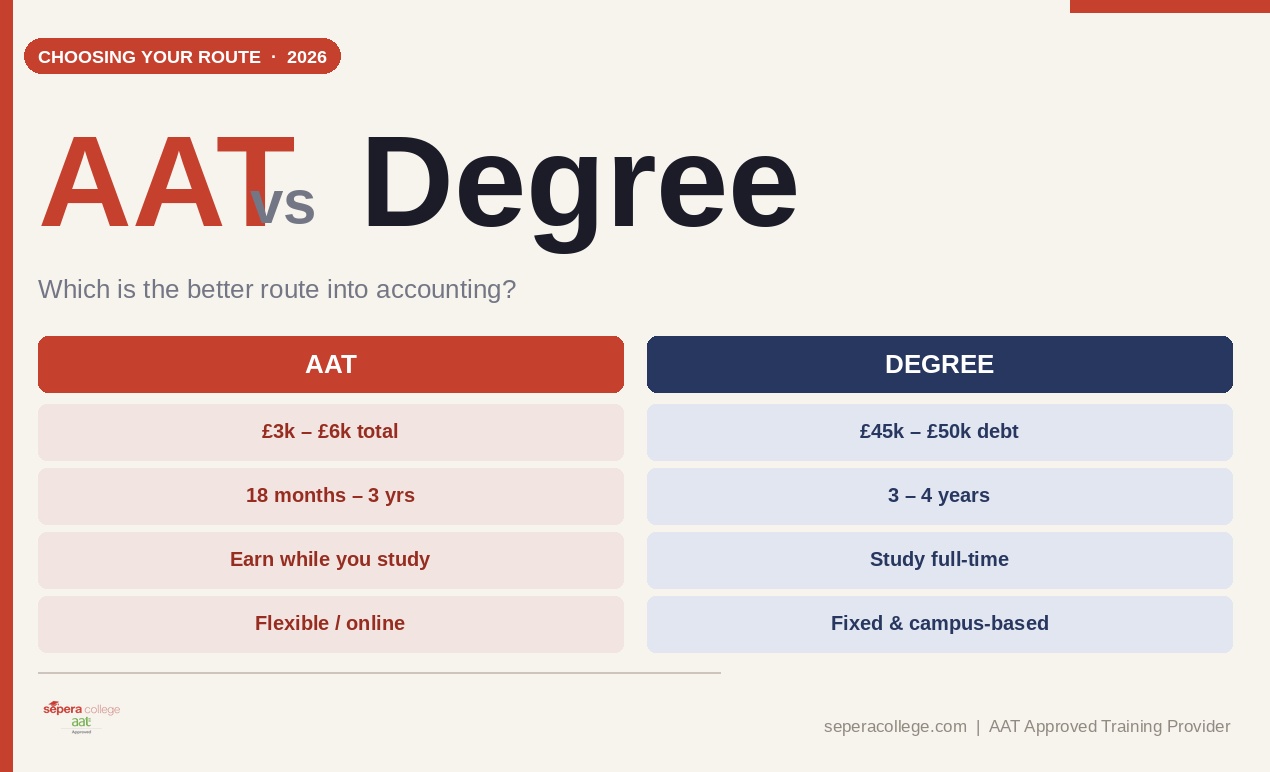
 The AAT vs degree question is one of the biggest decisions anyone considering an accounting career faces, and the honest answer is not the same for everyone. A university degree and the AAT qualification can both lead to a successful accounting career, but they take very different routes to get there, cost wildly different amounts, and suit very different people.
This guide compares AAT vs degree head to head across the factors that actually matter: cost, time, earning potential, how employers view each, and who each route genuinely suits. At Sepera College, we support students taking the AAT route, but this comparison is written to help you make the right decision, not just the one that sends you our way.
AAT vs Degree: The Quick Answer
If you want the short version: AAT is faster, dramatically cheaper, and gets you earning in accounting within months rather than years. A degree costs far more and takes longer, but opens certain doors, particularly graduate schemes at large audit firms, that AAT alone does not.
For most people who simply want a solid, well-paid accounting career without student debt, AAT is the more efficient route. For those specifically targeting a Big Four graduate scheme or who want the wider university experience, a degree may justify its cost. The rest of this guide unpacks exactly why.
AAT vs Degree on Cost
This is where the two routes differ most starkly. A three-year UK accounting degree charges tuition of up to £9,250 per year, which is roughly £27,750 in tuition alone before living costs are added. Most graduates in England finish with student debt around £45,000 to £50,000 once maintenance loans are included.
The complete AAT qualification, from Level 2 through Level 4, typically costs somewhere in the region of £3,000 to £6,000 in total depending on your provider and study method. That is less than a single year of university tuition, often less than a single term. There is no long-term debt repaid at 9% of your salary for decades afterwards.
On cost alone, the AAT vs degree comparison is not close. For a fuller breakdown of what AAT specifically costs and returns, see our honest look at whether AAT is worth it.
AAT vs Degree on Time
A traditional accounting degree takes three years full-time, or four with a placement year. During that time, you are generally studying rather than earning, at least not in a graduate accounting role.
The full AAT qualification typically takes 18 months to 3 years, but crucially you can work in accounting while you study. Many AAT students are employed in accounts roles from Level 2 onwards, earning and gaining real experience at the same time as gaining the qualification. By the time a degree student graduates, an AAT student who started at the same time could have two or three years of paid accounting experience behind them. For a detailed breakdown of AAT timescales, see our guide on how long AAT takes.
AAT vs Degree on Earning Potential
Here the picture is more nuanced than the cost comparison. Entry-level salaries for AAT-qualified professionals and accounting graduates are often broadly similar, both typically starting in the mid-to-high £20,000s depending on location and role.
The difference is what happens around those salaries. A degree graduate often starts their earning life with significant debt to service. An AAT student frequently reaches a similar salary with no debt and several years of experience already banked. According to AAT’s own data, professional members earn an average of around £35,000, and both routes can progress to £40,000 to £60,000 and beyond once you move into chartered study through ACCA or CIMA. The ceiling is not set by which route you started on. For a full salary breakdown by level, see our guide to AAT salaries in the UK.
AAT vs Degree: How Employers See Each
A common worry is that employers value a degree more highly. The reality is more balanced than many expect.
In small and medium-sized businesses and accounting practices, AAT is extremely well regarded, often more so than a degree from an unfamiliar university, precisely because it signals practical, job-ready skills from day one. Practices hiring bookkeepers, accounts assistants, and finance administrators frequently ask for AAT by name.
Where a degree still carries particular weight is the graduate schemes run by the largest accountancy firms, which often (though not always) expect a degree as a baseline entry requirement. If your specific ambition is a Big Four training contract straight out of education, a degree is the more conventional route. For most other accounting careers, AAT is not a disadvantage and is frequently an advantage.
AAT vs Degree on Flexibility
A degree is largely a fixed, full-time, location-based commitment for three years. AAT can be studied online, by distance learning, around a full-time job, or in a classroom, at whatever pace suits your life.
This flexibility is why AAT works so well for career changers, parents, and anyone who cannot simply stop working for three years to study. You do not have to relocate, give up your income, or put your life on hold. Our guide to AAT distance learning explains how studying around existing commitments actually works in practice.
Can You Do Both AAT and a Degree?
Yes, and some people do. AAT can be an excellent stepping stone taken before, instead of, or occasionally alongside further study. Some students complete AAT first to confirm accounting is genuinely for them and to start earning, then progress directly to chartered qualifications like ACCA or CIMA, skipping a degree entirely. Completing AAT Level 4 grants generous exemptions from several ACCA and CIMA papers, effectively giving you a head start on chartered study that a general degree may not.
This AAT-to-chartered route is often faster and far cheaper than the degree-to-chartered route, and you earn throughout rather than accumulating debt. It is one of the most underrated paths into professional accounting in the UK.
AAT vs Degree: Who Should Choose Which?
Choose AAT if you:
- Want to start earning in accounting quickly, within months rather than years
- Want to avoid significant student debt
- Are a career changer or need to study around work or family
- Prefer practical, job-focused learning over academic theory
- Want a recognised qualification employers ask for by name
Consider a degree if you:
- Specifically want a Big Four or large-firm graduate scheme straight away
- Want the wider university experience beyond just the qualification
- Are unsure whether accounting specifically is right for you and want a broader business education
- Have funding in place that makes the cost less of a concern
If you are still weighing it up, our free AAT level check helps you understand where you would start on the AAT route, and our guide on AAT entry requirements confirms just how accessible it is to begin.
The Bottom Line on AAT vs Degree
For the majority of people who want a professional accounting career efficiently and affordably, AAT wins the AAT vs degree comparison on cost, speed, flexibility, and debt avoidance, while leading to the same chartered qualifications and long-term earning potential. A degree retains an edge for specific goals like Big Four graduate schemes and for those who want the broader university experience.
The best route is the one that fits your circumstances, your budget, and your goals. If the AAT route sounds right for you, explore our AAT courses or read the official AAT qualifications overview to see the full pathway.
Frequently Asked Questions: AAT vs Degree
Is AAT better than a degree for accounting?
For most people wanting an efficient, affordable route into accounting, AAT is better: it is faster, far cheaper, and lets you earn while you study. A degree retains an advantage for specific goals like Big Four graduate schemes. Neither is universally better; it depends on your circumstances and ambitions.
How much cheaper is AAT than a degree?
Substantially. A full AAT qualification typically costs £3,000 to £6,000 in total, while a three-year accounting degree charges up to £9,250 per year in tuition alone, leaving most graduates with around £45,000 to £50,000 of debt including living costs.
Do you need a degree to become an accountant in the UK?
No. You do not need a degree to become an accountant in the UK. Many successful accountants qualify through AAT followed by chartered study with ACCA or CIMA, without ever completing a university degree.
Does AAT or a degree lead to a higher salary?
Entry salaries are often similar, typically in the mid-to-high £20,000s. Long-term earning potential is not determined by which route you started on, since both can progress to chartered qualifications and salaries of £40,000 to £60,000 and beyond. AAT students often reach these levels with no debt and more experience.
Can I do a chartered qualification after AAT instead of a degree?
Yes. Completing AAT Level 4 grants exemptions from several ACCA and CIMA papers, letting you progress directly to chartered study without a degree. This AAT-to-chartered route is often faster and cheaper than going via university.
How long does AAT take compared to a degree?
A degree takes three years full-time (four with a placement). The full AAT qualification takes 18 months to 3 years, but can be studied around a job, so you gain paid accounting experience during the same period a degree student is still studying.
Do employers respect AAT as much as a degree?
In most accounting settings, especially SMEs and practices, AAT is highly respected and often preferred because it signals practical, job-ready skills. Large-firm graduate schemes may still expect a degree, but for the majority of accounting roles AAT is not a disadvantage.
Is AAT or a degree better for a career change into accounting?
AAT is usually the stronger choice for career changers. It is flexible enough to study around an existing job, far cheaper, and gets you into accounting roles quickly, whereas a degree typically requires three years of full-time study and much higher cost.
Can I study AAT while working full time?
Yes. AAT is designed to be studied flexibly, including online and by distance learning, around full-time employment. This is one of its biggest advantages over a traditional full-time degree and a key reason career changers choose it.
Which should I choose, AAT or a degree?
Choose AAT if you want to start earning quickly, avoid debt, need flexibility, or prefer practical learning. Consider a degree if you specifically want a Big Four graduate scheme, want the wider university experience, or are unsure accounting is right for you and want a broader education first.
This article provides general guidance comparing AAT and a university degree as routes into accounting. Course costs, tuition fees, and salaries can change. Always check current details with AAT and individual universities before deciding.