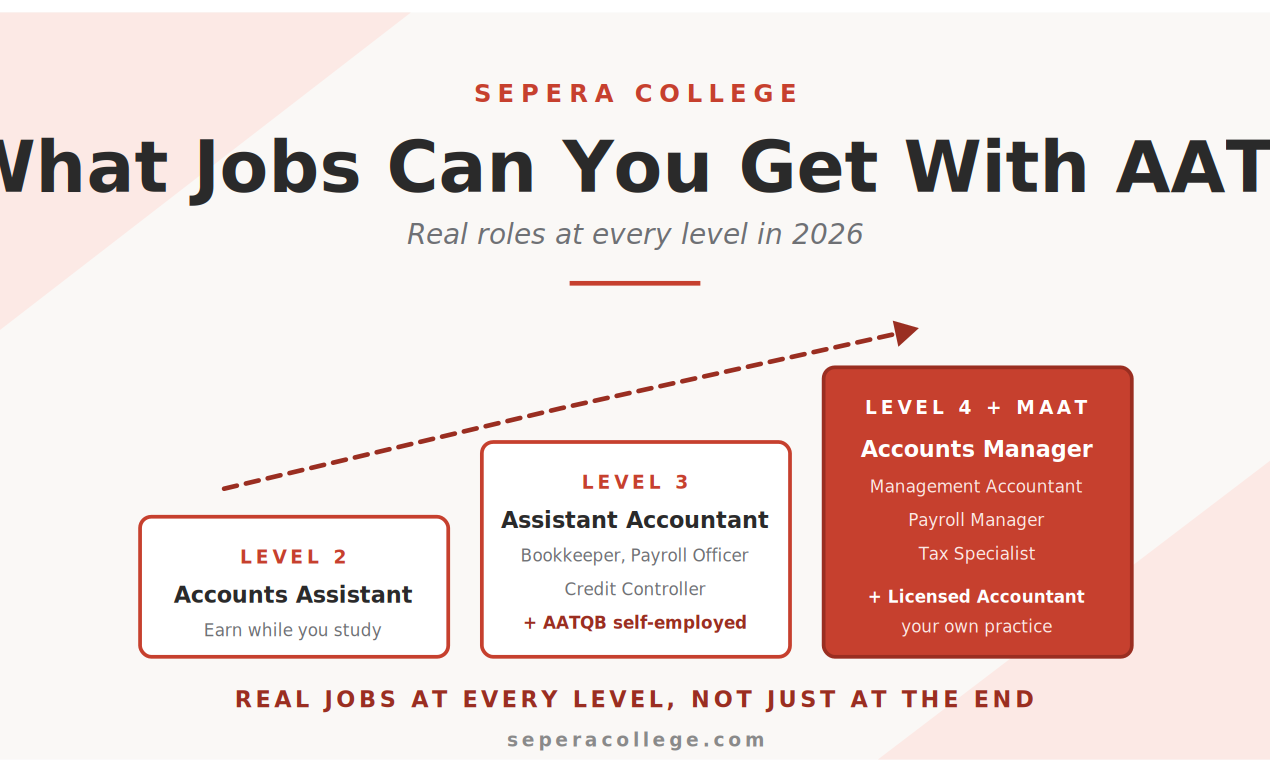
 Searching for AAT jobs before you enrol is exactly the right instinct. A qualification is only worth what it unlocks, and AAT’s biggest strength is that it unlocks real, advertised roles at every stage, not just at the end. You do not need to finish all three levels before employers take you seriously. Accounts assistant roles open up during Level 2, and by Level 4 you are qualified for management positions.
This guide maps the AAT jobs available at each level in 2026, what the roles actually involve day to day, how self-employment fits in, and how to make yourself the candidate that gets hired at each stage.
AAT jobs during and after Level 2
The Level 2 Certificate in Accounting covers the foundations: double-entry bookkeeping, costing, and the business environment. That is enough for genuine entry-level AAT jobs, and many students work in one while finishing the level:
- Accounts assistant: The classic first role. Processing invoices, reconciling supplier statements, chasing payments, supporting month-end. Most job adverts asking for “AAT studier” mean exactly this.
- Finance assistant: Similar work inside a company finance team rather than a practice, often with exposure to payroll and expenses.
- Accounts payable / receivable clerk: Specialised in one side of the ledger. High-volume processing roles that teach speed and accuracy.
- Trainee bookkeeper: In a small practice, handling client records under supervision.
- Payroll administrator (junior): Processing starters, leavers and timesheets, usually alongside study.
The important shift at this stage is identity: you stop applying as “someone with no experience” and start applying as “an AAT student”. Employers hiring for entry AAT jobs actively prefer studiers because the qualification signals commitment and gives them a development path to promote into.
AAT jobs after Level 3
The Level 3 Diploma in Accounting is where the qualification starts carrying real weight. Financial statements preparation, management accounting techniques and tax processes turn you from a processor into someone who can produce meaningful output. The AAT jobs that open up reflect that:
- Assistant accountant: The flagship Level 3 role. Preparing accounts to trial balance and beyond, VAT returns, month-end journals, supporting a qualified accountant.
- Bookkeeper: Running complete sets of records for businesses, either employed or within a practice, with genuine autonomy.
- Payroll administrator / officer: Owning the payroll cycle rather than assisting with it.
- Credit controller: Managing a debtor book, negotiating payment plans, holding real financial responsibility.
- Finance officer: A common title in charities, schools and the public sector, combining bookkeeping, reporting and administration.
- Accounts senior (small practice): In smaller firms, Level 3 plus experience can carry you to senior processing roles.
Level 3 is also the point where AAT bookkeeping membership becomes available, which matters for the self-employment route covered below.
AAT jobs after Level 4 and MAAT
The Level 4 Diploma in Professional Accounting, followed by MAAT membership once you have the work experience, is a complete professional qualification. The AAT jobs at this stage are management-level:
- Accounts manager: Running the accounts function of a small or medium business, or managing a portfolio of clients in practice.
- Management accountant: Budgets, forecasts, variance analysis and reporting that drives decisions. Level 4’s Applied Management Accounting unit maps directly to this work.
- Payroll manager: Owning payroll across an organisation, managing staff and compliance.
- Senior finance officer / finance manager: Common in the public and charity sectors, with budget responsibility.
- Tax specialist (VAT, personal or business tax): Level 4’s optional tax units open specialised routes in practice.
- Audit trainee / semi-senior: In firms that take AAT-qualified staff into audit teams, usually combined with further study.
MAAT status matters for these AAT jobs because it is the point where employers stop reading you as a student and start reading you as a qualified professional. The letters carry recognition across UK finance recruitment, and role adverts frequently list “AAT qualified (MAAT)” as the requirement.
Self-employment: the AAT jobs you create yourself
Not every AAT career leads to employment. AAT licensed membership lets you practise in your own name, and for many students that is the destination:
- Licensed bookkeeper (AATQB): Available from Level 3 with the bookkeeping membership. Offer bookkeeping, VAT and payroll services to your own clients legally and with professional indemnity insurance.
- Licensed accountant (MAAT with a practising licence): Available after Level 4 and MAAT. Offer accounts preparation, tax returns and advisory services to the public.
Self-employed bookkeeping is one of the most flexible careers available around family life, and demand from small businesses is constant. Many Sepera College students specifically target this route: qualify, license, and build a client base gradually while employed.
Where AAT jobs are advertised, and what employers look for
AAT jobs appear across the general job boards (Indeed, Reed, Totaljobs), specialist finance recruiters (Hays, Michael Page, Robert Half), the AAT’s own job board, and increasingly LinkedIn. When you search, use the level-appropriate titles from this guide rather than “AAT” alone, because many relevant adverts never mention the qualification by name.
Across all levels, the things that consistently separate hired candidates from rejected ones:
- Software skills: Xero, QuickBooks and Sage appear in most adverts for AAT jobs. Excel to a confident standard (lookups, pivot tables) is assumed almost everywhere.
- Evidence of study momentum: “Currently studying Level 3, exams booked” reads far better than an unexplained pause.
- Any finance-adjacent experience: Retail cash handling, admin with invoicing, volunteer treasurer roles. Small experience translates surprisingly well.
- Communication: Every accounting role involves explaining numbers to people who do not love numbers. Interviews test this more than technical knowledge at junior levels.
Do you need to finish AAT before applying?
No, and waiting is usually a mistake. The strongest financial argument for AAT is earning while you study: a Level 2 student in an accounts assistant role is gaining the experience that MAAT membership will later require, getting employer exposure to real systems, and often having later levels funded by the employer. Apply for AAT jobs as soon as you have started studying, not when you finish.
For what these roles actually pay at each stage, our AAT salary guide has the current figures. And if you are still weighing whether the qualification makes sense for your situation at all, our honest is AAT worth it breakdown covers the cost-benefit question directly.
Frequently Asked Questions
What jobs can I get with AAT Level 2?
Accounts assistant, finance assistant, accounts payable or receivable clerk, trainee bookkeeper and junior payroll administrator. Many students work in these AAT jobs while completing the level, since employers actively recruit current studiers.
What jobs can I get with AAT Level 3?
Assistant accountant is the flagship role, alongside bookkeeper, payroll officer, credit controller and finance officer positions. Level 3 also unlocks AAT bookkeeping membership, which permits licensed self-employed bookkeeping.
What jobs can I get with AAT Level 4?
Accounts manager, management accountant, payroll manager, senior finance officer and specialised tax roles. With MAAT membership after qualifying, employers treat you as a fully qualified professional for these positions.
Can I work for myself with AAT?
Yes. AAT licensed membership allows self-employed practice: as a licensed bookkeeper (AATQB) from Level 3, or as a licensed accountant offering accounts and tax services with MAAT status after Level 4. Both routes require professional indemnity insurance and CPD.
Do AAT jobs require experience as well as the qualification?
Entry-level AAT jobs generally do not; employers expect to train you. From assistant accountant upwards, adverts usually want some practical experience, which is exactly why starting work during your studies matters. MAAT membership itself requires demonstrated work experience.
Start the qualification that starts the career
The AAT jobs map is the honest answer to “what will this qualification actually do for me”: real roles at every level, employment or self-employment, with progression that does not wait for graduation day. The next step is choosing the level and study mode that fits your life.
Book a free consultation with Sepera College and we will help you pick the right starting level, plan study around your work, and target the first role realistically. For the official qualification framework, see the AAT website.