 It’s the question we’re asked more than any other at enrolment: should I start with the AAT bookkeeping course or go straight for the accounting one? Both sit at Level 2, both are respected AAT qualifications, both open doors into finance work, and the two names sound close enough that plenty of people pick one without quite knowing what the other would have given them.
At Sepera College, an AAT approved training provider, we teach both, which means we have no reason to steer you either way, and every reason to help you pick right first time. This guide sets out what each course actually covers, the real differences in time, cost and destination, the overlap that makes switching painless, and the five questions that settle the decision in almost every case.
The Two Courses in Plain English
The AAT Level 2 Certificate in Bookkeeping is the short, focused option: it teaches you double entry bookkeeping properly, from processing transactions to controls and reconciliations, across two units. It exists for people who want a recognised finance qualification quickly, whether to land bookkeeping work, support their own business, or test the water before committing further.
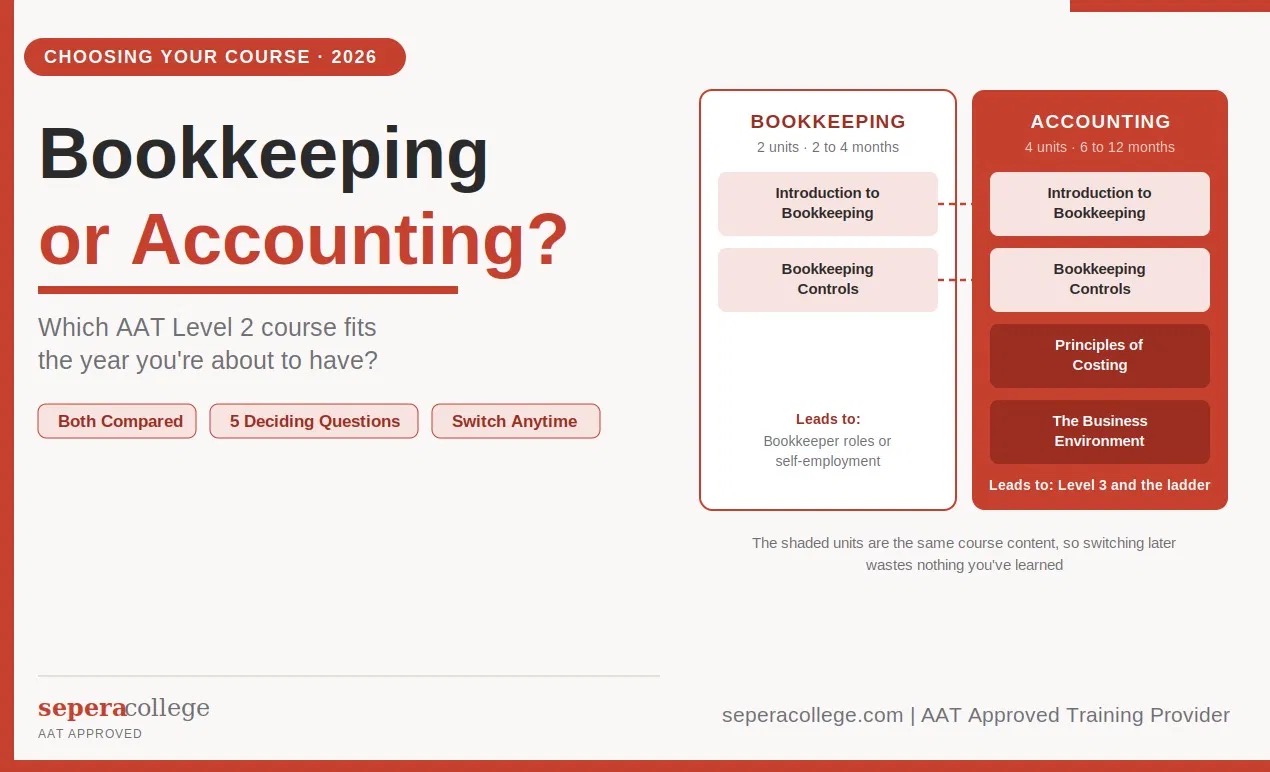
The AAT Level 2 Certificate in Accounting is the full foundation qualification: it contains the same bookkeeping skills and then goes wider, adding costing and the business environment, across four units. It’s the standard first rung of the AAT ladder that runs through Level 3 and Level 4 towards professional MAAT status, as set out by the Association of Accounting Technicians.
So the honest one-line summary of AAT bookkeeping vs accounting is this: one is a destination, the other is a doorway. Which you need depends on where you’re going, which is what the rest of this guide works out. And a reassurance before we start: because of how the two qualifications are built, choosing “wrong” costs far less than most people fear, as you’ll see in the overlap section below. This is a decision worth making carefully but not one worth agonising over.
What Each Course Covers
| Certificate in Bookkeeping | Certificate in Accounting | |
|---|---|---|
| Units | Introduction to Bookkeeping; Principles of Bookkeeping Controls | Introduction to Bookkeeping; Principles of Bookkeeping Controls; Principles of Costing; The Business Environment |
| Exams | 2, booked on demand when you’re ready | 4, booked on demand when you’re ready |
| Typical study time | Around 2 to 4 months part time | Around 6 to 12 months part time |
| Leads to | Bookkeeping roles, self-employed bookkeeping, or topping up to the Accounting certificate | Accounts assistant roles and direct progression to AAT Level 3 |
Look at the units and you’ll spot the structural fact that shapes everything else: the two AAT bookkeeping units are the first two units of the accounting qualification. The bookkeeping certificate isn’t a different subject; it’s the core of the bigger course, packaged to stand alone.
The Real Differences: Time, Cost and Destination
- Time. AAT bookkeeping is roughly half the content, so committed students finish in a few months. The accounting certificate typically takes 6 to 12 months part time. If you need a certificate on your CV by spring, that difference matters.
- Depth versus speed. The AAT bookkeeping course goes deep on one skill; the accounting course goes wide across four. Neither is “easier” per unit, the exams expect the same standard, but the shorter course asks less of your diary overall.
- Cost. Fewer units means lower tuition and fewer exam fees overall for the bookkeeping route. Our Level 2 Accounting course is £340 (or £49 a month over 7 months interest free) plus AAT registration and exam fees per unit; the bookkeeping course is priced on our course pages, and because AAT registration is per qualification, ask us for a full journey quote for whichever you’re considering so you compare like with like.
- Destination. This is the one that should drive the decision. The accounting certificate is built to continue: Level 3, Level 4, MAAT letters, and the broadest range of junior finance roles. The bookkeeping certificate is built to deploy: a complete, respected credential for doing bookkeeping work now, including for your own clients.
The Overlap Most People Miss (and Why a “Wrong” Choice Barely Exists)
Because the AAT bookkeeping units sit inside the accounting qualification, this decision is nowhere near as risky as it feels. Start with AAT bookkeeping and later want the full qualification? The ground you covered is exactly where the accounting course begins, so nothing you learned is wasted. Start with accounting and realise bookkeeping work is all you wanted? You’ll have the bookkeeping skills and more.
The genuine cost of picking “wrong” is time and some duplicated exam planning, not dead-end learning. That should lower the temperature on the whole decision: you are choosing a starting point, not a life sentence. Pick the course that matches the next 12 months of your life, and let the one after that take care of itself. One practical note if you think a switch is likely: mention it when you enrol, because registration and exam planning can be arranged with the move in mind, which saves money and admin later.
Who Should Choose AAT Bookkeeping
The AAT bookkeeping certificate tends to be the right call when:
- You want to earn from this quickly. A few months of study produces a standalone credential that bookkeeping employers and clients recognise.
- Self-employment is the goal. For running your own bookkeeping service around family or another job, the bookkeeping certificate is the natural first step, and AAT’s licensed membership routes exist for exactly this path.
- You run a business and want to do your own books properly. Two units of proper training beats years of guesswork in a spreadsheet.
- You’re testing the water. If you’re not yet sure finance is your career, the shorter commitment answers the question cheaply, and tops up cleanly if the answer is yes.
- Your funding or budget covers a shorter course. A smaller, quicker qualification is sometimes the easier case to make, a point covered in our guide to getting a free AAT course through Jobcentre funding.
Who Should Choose AAT Accounting
- You’re building a career, not just a skill. If you can already picture Level 3, MAAT letters, or a finance office five years from now, start on the ladder that goes there.
- You’re a career changer. The full certificate signals commitment to employers and gives you costing and business knowledge that junior accounting roles use daily. Our guide to a career change to accounting walks the whole journey.
- You want the widest choice of first jobs. Accounts assistant, finance assistant, purchase ledger, sales ledger: the broader certificate fits the broader job pool.
- An employer is involved. Workplaces supporting study almost always prefer the qualification with a progression route, because they’re investing in your next role as well as this one.
The Jobs Each Course Leads To
Both qualifications are employment focused, but the job pools differ in shape more than in prestige.
With the AAT bookkeeping certificate, the natural roles are bookkeeper, bookkeeping assistant, and accounts administration positions where transaction processing is the core of the job. The other destination, and for many students the whole point, is self-employment: doing the books for local trades, salons, landlords and small firms, work that fits around school hours and scales from a side income to a full practice. Every small business in the country needs its books kept, and most of them would rather pay someone qualified than do it themselves at midnight.
With the accounting certificate, the pool widens to accounts assistant, finance assistant, purchase ledger and sales ledger roles in finance teams of every size, the positions that come with colleagues, progression reviews and employers who fund Level 3. It’s normal to land one of these while still studying, which is how the qualification starts paying for itself before it’s finished.
Notice that neither list outranks the other; they’re different working lives. Independent and flexible versus structured and progressive is a lifestyle question as much as a career one, and you’re allowed to pick on lifestyle. We’ve enrolled parents who chose AAT bookkeeping precisely because invoicing three clients from the kitchen table beats commuting, and career changers who chose accounting precisely because they wanted the office, the team and the ladder. Both were right, because both matched the course to the life they actually wanted.
Is Bookkeeping Still Worth Learning in the Age of Software?
A fair question in 2026, with cloud accounting software automating more of the keystrokes every year. The honest answer: the typing is automating, the understanding is not. Software posts transactions, but someone has to know which ones are wrong, why the bank doesn’t reconcile, and what the numbers mean, and that someone is the person with AAT bookkeeping training rather than the person with a login. Small businesses increasingly need fewer hours of bookkeeping help, but they need those hours from someone who understands what the software did, which has quietly raised the value of qualified bookkeepers rather than lowered it.
It’s also why we’d gently steer you away from learning bookkeeping from random online videos alone. The AAT bookkeeping syllabus forces the double entry logic into place in an order that builds, with exams that check it stuck, and that structure is exactly what separates “I can use the software” from “I can be trusted with your books”. Either Level 2 certificate delivers it; the choice is only about how far past it you want to go.
The 5 Questions That Decide AAT Bookkeeping or Accounting
- What do you want to be doing in 18 months? Running your own books or a bookkeeping side business points one way; working in a finance team points the other.
- How much time can you give it each week? Both courses fit around life, but if study time is genuinely scarce this year, finishing the shorter course beats stalling halfway through the longer one. An unfinished qualification helps nobody.
- Do you need a credential by a deadline? A job application window or a business launch date favours AAT bookkeeping; no deadline favours the fuller course.
- Who’s paying? Self-funding on a tight budget, employer backing, or Jobcentre support each tilt the maths differently, and we’ll happily quote both routes so you can compare.
- Does the idea of stopping bother you? Some people know they’ll want the next level before they’ve finished this one. If that’s you, skip the detour and start the accounting certificate; the ladder is the point.
If after all five you’re still torn, here’s our honest tiebreaker from years of teaching both: career changers and ladder climbers rarely regret starting with the full accounting certificate, and time-poor practical learners rarely regret the fast AAT bookkeeping win. Mismatches almost always come from picking a course for the person you think you should be rather than the year you’re actually about to have.
Studying Either Course with Sepera College
Whichever side of the AAT bookkeeping or accounting line you land on, the Sepera College experience is the same: online, self-paced study with rolling start dates (enrol this week, start this week), tutor support when you need it, accounting software included, and AAT exams booked on demand when you’re ready rather than in fixed seasons, with Ealing Broadway as our main exam centre and any AAT approved venue available to online students. The AAT Level 2 Certificate in Accounting is £340, or £49 a month over 7 months interest free, with 14 months of course access and most students finishing inside 6 to 12. And if you start one course and your plans change, we’ll help you move to the other with everything you’ve learned intact. Contact the team for a full quote on either route, including a funding-ready version for your work coach if you’re applying through the Jobcentre.
Course prices and fees are correct at the time of writing; AAT registration and assessment fees are set by AAT and paid separately. This article is general guidance, so contact us for advice on your own situation before enrolling.
Frequently Asked Questions
What is the difference between AAT bookkeeping and AAT accounting at Level 2?
The Certificate in Bookkeeping covers two units focused on double entry bookkeeping and controls, taking a few months. The Certificate in Accounting contains those same two units plus costing and the business environment, four units in all, and is the standard route onto the full AAT ladder towards Levels 3 and 4.
Is the AAT bookkeeping course included in the accounting course?
In content terms, yes. The two bookkeeping units are the first two units of the Level 2 Certificate in Accounting, so bookkeeping study transfers naturally if you later move to the fuller qualification, and nothing you learn is wasted either way.
How long does the AAT bookkeeping course take?
The AAT Level 2 Certificate in Bookkeeping typically takes around 2 to 4 months part time, since it’s two units with exams booked on demand when you’re ready. The Certificate in Accounting typically takes 6 to 12 months part time.
Can I work as a bookkeeper with the AAT bookkeeping certificate?
Yes. It’s a recognised standalone credential for bookkeeping roles and for doing clients’ books, and AAT offers licensed membership routes for those building a self-employed bookkeeping practice.
Which course is better for a career change into finance?
Usually the Certificate in Accounting, because it signals commitment, covers more ground, and leads directly to Level 3 and beyond. The bookkeeping certificate suits career changers who need a quicker credential first, and it tops up cleanly later.
Can I start with AAT bookkeeping and switch to accounting later?
Yes, and it’s a common path. Because the bookkeeping units sit inside the accounting qualification, you continue from where you stopped rather than starting again. We help students make exactly this move.
How much does the AAT Level 2 Accounting course cost at Sepera College?
£340 as a one-off payment, or £49 a month for 7 months interest free, with 14 months of course access and accounting software included. AAT registration and per-unit exam fees are paid separately, and we provide a full journey quote on request for either course.
Can I get funding for either course?
If you claim Universal Credit or Jobseeker’s Allowance, Jobcentre Plus can fund job-focused training where your work coach agrees it will help you into work, and the decision is theirs. We prepare funding-ready quotes for both courses; our free AAT course guide explains the whole process step by step.