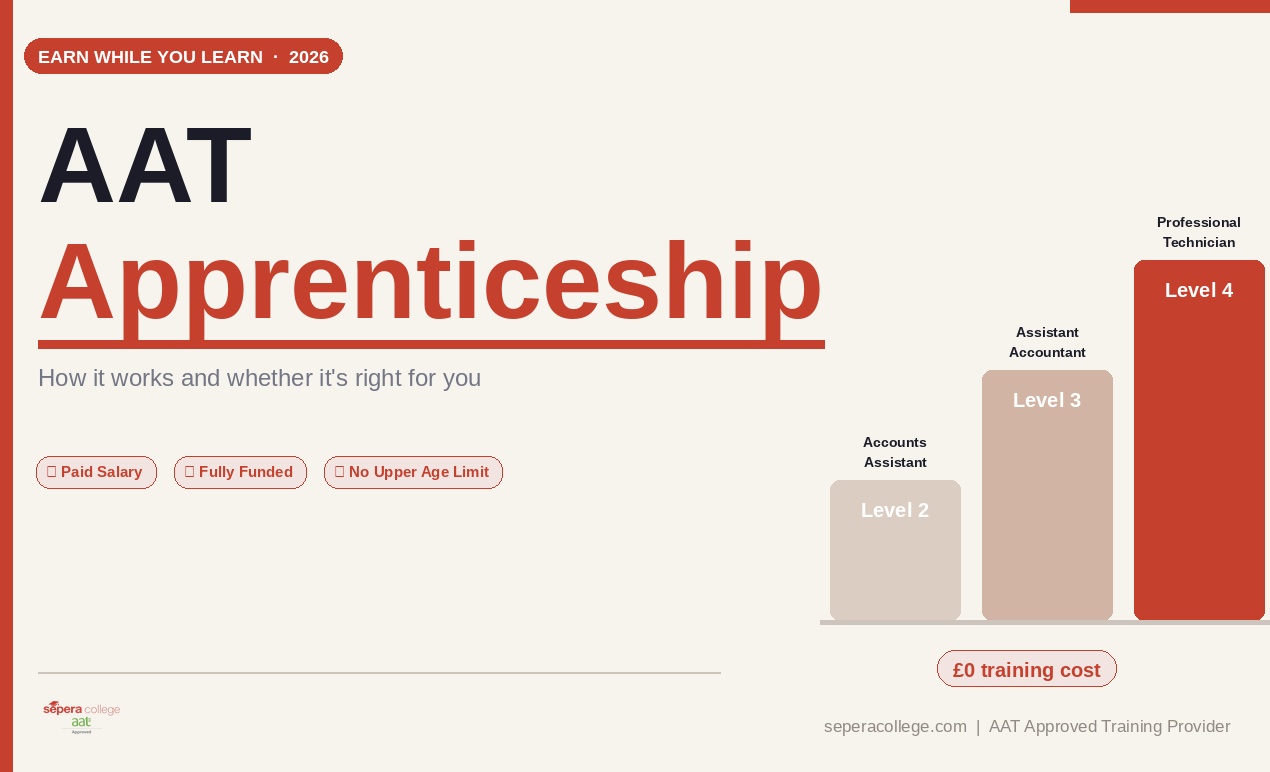
 An AAT apprenticeship lets you earn a salary while working toward a recognised accounting qualification, with your training costs covered through the employer’s Apprenticeship Levy rather than paid by you. It is one of the most debt-free routes into finance available in the UK, and for the right person, it can be genuinely faster and cheaper than any other path into the profession.
This guide explains exactly how the apprenticeship route works in 2026: the levels available, what you earn, how funding works, and how it compares to self-funded study. At Sepera College, we support students on both paths, and this article sets out the honest picture of when each one makes sense.
What Is an AAT Apprenticeship?
An accounting apprenticeship combines paid employment with structured study toward an AAT qualification. You work for an employer in a genuine finance role, typically spending at least 20% of your working hours on off-the-job training, while studying toward AAT Level 2, Level 3, or Level 4 depending on which apprenticeship standard you are enrolled on.
At the end of the programme, you sit an End Point Assessment, a final evaluation covering the knowledge and skills built up throughout your apprenticeship, in addition to completing your AAT qualification itself. According to AAT’s own apprenticeships guidance, three accounting apprenticeship standards exist at Levels 2, 3, and 4, each building your qualification and practical workplace experience side by side.
The Three AAT Apprenticeship Levels
Level 2: Accounts/Finance Assistant apprenticeship
Aligns with the AAT Level 2 Certificate in Accounting or Bookkeeping. This is the standard entry point for school leavers or career changers with no prior accounting background. Roles at this level typically include Accounts Assistant, Purchase Ledger Clerk, and similar junior finance positions.
Level 3: Assistant Accountant apprenticeship
Aligns with the AAT Level 3 Diploma in Accounting. Suited to those with some existing finance experience or who have already completed Level 2. This standard develops more advanced technical and professional skills in preparation for assistant accountant level roles.
Level 4: Professional Accounting/Taxation Technician apprenticeship
Aligns with the AAT Level 4 Diploma in Professional Accounting. This is the most advanced route and typically leads directly into chartered study, since completing Level 4 grants generous exemptions with ACCA, ICAEW, CIMA, ICAS, and CIPFA.
Some apprentices start their journey at Level 2 and progress through all three levels with the same or different employers over several years, while more experienced candidates sometimes enter directly at Level 3 or Level 4.
How Much Does an AAT Apprenticeship Pay?
As an apprentice, you are a genuine employee and are legally entitled to at least the National Minimum Wage for apprentices, which for 2026 stands at £8.00 per hour in your first year, with age-related increases applying thereafter. Many employers pay considerably more than the statutory minimum, particularly larger accountancy firms and finance departments competing for strong candidates.
Beyond salary, apprentices receive standard employee benefits including holiday allowance, pension contributions, and often additional perks depending on the employer. Combined with zero training costs and no student debt, the total financial position of an apprentice compares very favourably with the university route into finance.
How AAT Apprenticeship Funding Works
Apprenticeship funding in England flows through the government’s levy system rather than being paid by the learner.
Large employers (annual wage bill over £3 million) pay into the Apprenticeship Levy and draw down funds to cover training costs for their apprentices.
Smaller employers (wage bill under £3 million) typically have the majority of training costs covered by the government, contributing a small percentage themselves, generally around 5% for apprentices aged 22 and over. For apprentices aged 16 to 21, government funding often covers the training cost in full.
The Level 2 Accounts/Finance Assistant apprenticeship sits within a funding band capped at £6,000, which is administered by the employer and spent with their chosen training provider. Crucially, none of this funding is something you arrange or pay for yourself. It is entirely negotiated between your employer and their chosen training provider.
Who Can Apply for an AAT Apprenticeship?
Apprenticeships alongside AAT are genuinely open to a wide range of people. According to AAT, there is no upper age limit. You must simply be over 16, not in full-time education, and have lived in the UK or European Economic Area for at least three years.
This means the route suits school leavers choosing between university and employment, as well as adults in their 30s, 40s, and beyond who are changing career and want to avoid both university debt and lost earnings during study. If a career change into accounting is something you are weighing up more broadly, our guide on career change into accounting covers the wider decision in more depth.
The Honest Trade-Off: Apprenticeship vs Self-Funded Study
An apprenticeship is an excellent route, but it is not automatically the right or the only route, and it comes with a genuine constraint worth understanding before you plan around it.
The advantage: you earn from day one, your training is fully funded, and you gain structured workplace experience alongside your qualification. There is no faster way to combine income, experience, and study simultaneously.
The constraint: apprenticeship places are set by individual employers, are competitive, and are concentrated in certain locations and industries. You cannot simply decide to start an apprenticeship the way you can enrol on a self-funded course. You need an employer willing to take you on in that specific role, and demand regularly outstrips supply, particularly for well-known firms.
Self-funded study through a training provider gives you a route you control entirely. You choose your start date, your pace, and are not dependent on securing a specific employer’s apprenticeship vacancy. The AAT qualification gained is identical either way. Employers do not distinguish between apprenticeship-route and self-funded AAT graduates once qualified. Our courses at Sepera College give you that flexibility, with the option to combine study with your existing job rather than waiting for the right apprenticeship vacancy to appear.
How to Find and Apply for an AAT Apprenticeship
Apprenticeship vacancies are advertised individually by employers rather than through training providers directly. Some practical starting points:
- AAT’s Apprenticeships Hub, which lists finance internships, traineeships, and entry-level apprenticeship roles
- The government’s national Find an Apprenticeship service, which lists live vacancies across all sectors
- Direct applications to accountancy firms and finance departments who advertise apprenticeship intakes, often on a seasonal cycle
- Specialist apprenticeship training providers, who work with employer networks and often have visibility of upcoming vacancies before they are advertised publicly
Because places are competitive, applying broadly and early in the recruitment cycle materially improves your chances. Many large employers run structured apprenticeship intakes once or twice a year with defined application windows.
What Happens After Your AAT Apprenticeship?
Completing an apprenticeship at Level 4 or above gives significant long-term career value. Government research shows those completing an apprenticeship at Level 4 or above could earn considerably more over their lifetime on average than peers without an apprenticeship, and AAT reports that a large majority of apprentices feel it positively improved their career prospects.
From there, many apprentices progress into chartered study through ACCA, ICAEW, CIMA, ICAS, or CIPFA, using the exemptions their AAT Level 4 qualification provides. Others move directly into full-time employed roles at assistant accountant level or above, using their apprenticeship-built workplace experience as a genuine advantage over candidates with qualifications but no practical background.
If you complete your AAT qualification and want to understand what comes next, our guide on becoming a MAAT member after Level 4 sets out the professional membership route in detail.
If You Cannot Secure an AAT Apprenticeship Place
If apprenticeship places in your area or industry are limited, or you need to start studying sooner than a vacancy allows, self-funded study is a completely credible alternative rather than a consolation prize. The qualification you receive is exactly the same, and many successful finance professionals never took the apprenticeship route at all.
Sepera College offers flexible online, London, and Manchester study options across every AAT level. If cost is the main barrier rather than employer availability, our free AAT courses guide explains how eligible learners on Universal Credit or Job Seeker’s Allowance can access funded study through the Jobcentre Plus scheme, an alternative debt-free route that does not depend on securing a specific employer’s apprenticeship vacancy.
Not sure which AAT level to start at, whichever route you take? Try our free AAT level check to find your starting point.
Frequently Asked Questions: AAT Apprenticeship
What is an AAT apprenticeship?
It is a programme combining paid employment with study toward an AAT qualification at Level 2, 3, or 4. Training costs are covered through the employer’s Apprenticeship Levy rather than paid by the apprentice, and the apprentice earns a salary throughout.
How much does an AAT apprentice earn?
Apprentices are entitled to at least the National Minimum Wage for apprentices, £8.00 per hour in the first year as of 2026, with age-related increases after that. Many employers, particularly larger accountancy firms, pay above the statutory minimum.
Is an AAT apprenticeship free?
Yes, for the apprentice. Training costs are covered through the Apprenticeship Levy for large employers, or largely government-funded with a small employer contribution for smaller businesses. The apprentice never pays for their own training under this route.
What is the difference between an AAT apprenticeship and self-funded AAT study?
An apprenticeship combines a paid job with fully funded training but requires securing a specific employer vacancy, which can be competitive. Self-funded study through a training provider gives you full control over your start date and pace, without needing to find an employer offering an apprenticeship place first. The qualification gained is identical either way.
Can adults over 25 do an AAT apprenticeship?
Yes. AAT confirms there is no upper age limit for apprenticeships. You must be over 16, not in full-time education, and have lived in the UK or EEA for at least three years, making the route open to career changers of any age.
How do I find an AAT apprenticeship vacancy?
Vacancies are advertised by individual employers, so check AAT’s Apprenticeships Hub, the government’s national Find an Apprenticeship service, and apply directly to accountancy firms and finance departments running apprenticeship intakes.
What happens if I can’t get an apprenticeship place?
Self-funded study is a fully credible alternative producing an identical AAT qualification. Eligible learners on Universal Credit or Job Seeker’s Allowance may also access government-funded study through the Jobcentre Plus scheme, which does not depend on finding an employer apprenticeship vacancy first.
Does completing an AAT apprenticeship lead to chartered accountancy?
Completing the Level 4 Professional Accounting Technician apprenticeship, which aligns with AAT Level 4, grants generous exemptions with ACCA, ICAEW, CIMA, ICAS, and CIPFA, making it a strong and commonly used stepping stone toward chartered status.
How long does an AAT apprenticeship take?
Duration varies by level and employer, but Level 2 apprenticeships typically run around 12 to 18 months, with Level 3 and Level 4 taking longer due to increased complexity. Your specific timeline is set out in your apprenticeship agreement with your employer and training provider.
Do I need any qualifications to start an AAT apprenticeship?
Entry requirements are set by individual employers rather than by AAT centrally, but Level 2 apprenticeships typically expect GCSEs including English and Maths, while Level 3 and Level 4 apprenticeships often expect prior AAT study or relevant work experience.
This article provides general guidance on the AAT apprenticeship route in the UK. Apprenticeship funding rules, wage rates, and entry requirements can change. Check current details with AAT and individual employers before applying.