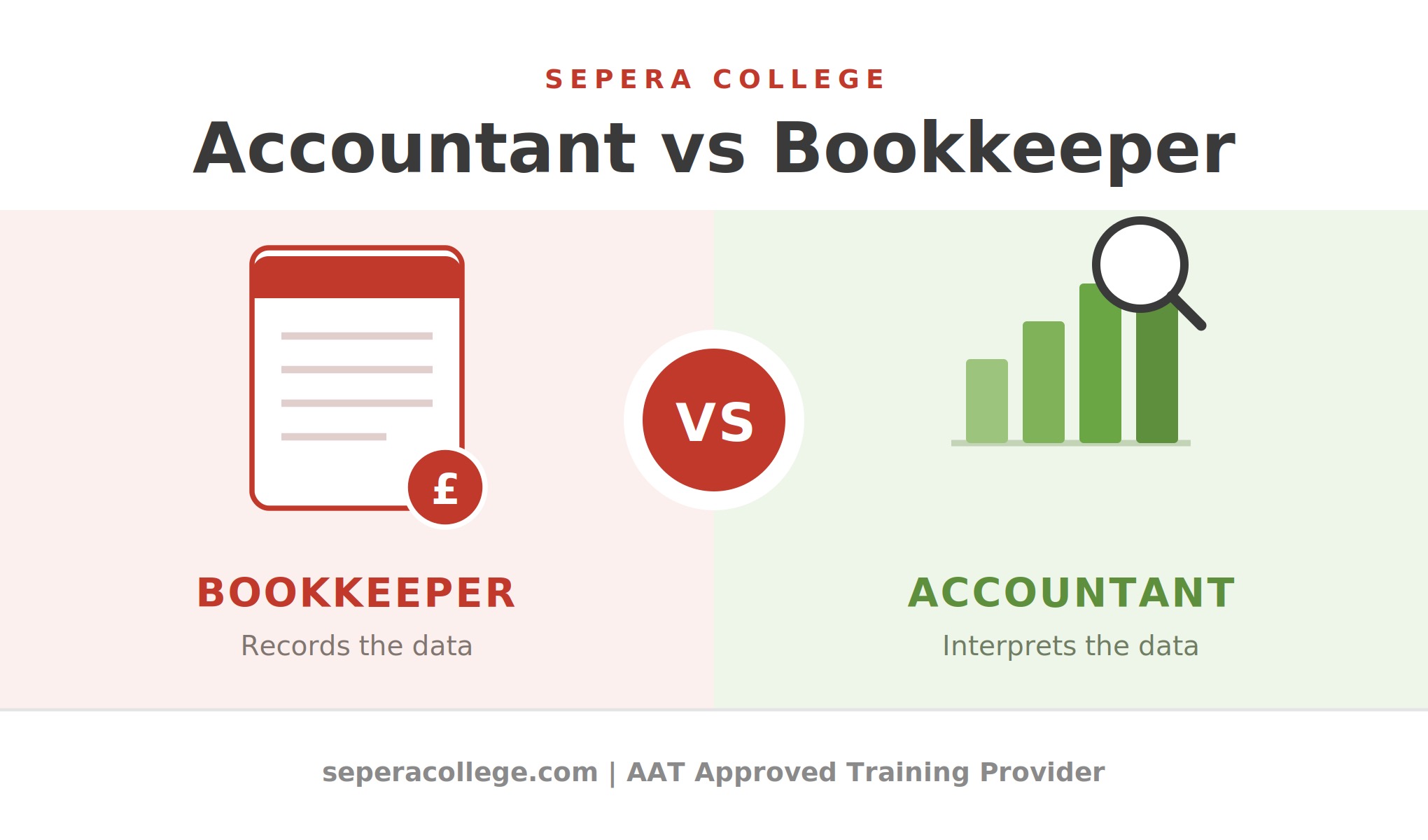
 If you are considering a career in finance, one question comes up again and again: accountant vs bookkeeper, what is the actual difference, and which one should you train for?
It is a brilliant question to ask. Although the two roles are closely related and often confused, they are not the same job. They involve different tasks, different qualifications, different salaries and different day-to-day working lives.
This guide breaks down the accountant vs bookkeeper question in plain English. By the end, you will know exactly what each role does, what you need to study, what you can expect to earn, and which path fits you best in the UK in 2026.
Accountant vs bookkeeper: the simple difference
Here is the accountant vs bookkeeper difference in one sentence: a bookkeeper records the financial data, and an accountant interprets it.
Think of it like building a house. The bookkeeper lays the bricks, recording every transaction accurately and keeping the financial records in order. The accountant is the architect, taking those solid foundations and turning them into reports, advice and strategy.
Both roles are essential. A business cannot have reliable accounts without good bookkeeping, and it cannot make smart financial decisions without good accounting. They are two halves of the same process, which is exactly why the accountant vs bookkeeper comparison matters so much when you are choosing what to study.
What does a bookkeeper do?
A bookkeeper is responsible for recording and organising a business’s day-to-day financial transactions. The work is detailed, methodical and central to keeping a business running smoothly.
Typical bookkeeping tasks include:
- Recording sales, purchases, receipts and payments.
- Maintaining accurate ledgers and journals.
- Reconciling bank statements against the records.
- Processing invoices and chasing outstanding payments.
- Managing payroll in some roles.
- Preparing and submitting VAT returns.
- Bringing the books to what is known as the trial balance stage.
Bookkeepers tend to work with the numbers as they happen, week to week and month to month. Accuracy matters enormously here, because everything an accountant does later depends on the quality of the bookkeeping underneath it.
What does an accountant do?
An accountant takes the financial information a bookkeeper has prepared and uses it to produce reports, ensure compliance and advise on decisions.
Typical accounting tasks include:
- Preparing annual financial statements and accounts.
- Completing and filing tax returns.
- Analysing financial performance and trends.
- Advising on budgets, cash flow and business growth.
- Making sure the business meets HMRC and Companies House requirements.
- Supporting major decisions such as investment, hiring or expansion.
Accountants work at a more analytical and advisory level. Where a bookkeeper answers the question “what happened”, an accountant answers “what does it mean, and what should we do next”. That is the real heart of the accountant vs bookkeeper distinction: recording versus interpreting.
Accountant vs bookkeeper: a typical working day
A good way to settle the accountant vs bookkeeper question in your own mind is to picture a typical working day in each role.
A bookkeeper’s day is built around keeping records accurate and up to date. It might involve entering the morning’s invoices, reconciling a bank feed, processing a supplier payment run, updating the payroll figures, and making sure every transaction is filed in the right place. It is satisfying, structured work with a clear daily rhythm.
An accountant’s day looks different. It might involve reviewing a client’s year-end figures, preparing a tax computation, analysing why a department has gone over budget, and meeting a business owner to talk through their growth plans. There is more variety, more judgement and more direct advice involved.
Neither day is better than the other. The accountant vs bookkeeper choice is really about which of those two working days sounds more like the life you want.
Accountant vs bookkeeper: qualifications compared
One of the biggest differences in the accountant vs bookkeeper question is the level of qualification each role usually requires.
Bookkeeper. In the UK, “bookkeeper” is not a legally protected title, which means anyone can technically call themselves one. In practice, though, employers and clients want proof of competence. A recognised bookkeeping qualification, such as an AAT bookkeeping certificate, is the standard way to show you can do the job properly.
Accountant. Becoming an accountant usually means studying further. Many accountants start with the AAT accounting qualification and then progress to chartered-level study if they wish. Certain specialist work, such as auditing, is restricted by law to registered professionals, which is why accountancy involves a longer study path.
The good news for anyone weighing up accountant vs bookkeeper is that you do not have to choose forever on day one. Both paths often begin in exactly the same place, with a recognised entry-level qualification from a body such as the AAT.
Accountant vs bookkeeper: salary compared
Salary is naturally a big part of the accountant vs bookkeeper decision, so it is worth being clear about realistic figures.
As a general guide in the UK in 2026:
- Bookkeepers typically earn between around £22,000 and £32,000, with experienced or self-employed bookkeepers often earning more.
- Accountants typically earn between around £28,000 and £55,000 or higher, rising significantly with experience, responsibility and chartered status.
Accountants generally earn more because the role demands more advanced qualifications and carries greater responsibility. However, bookkeeping offers a faster route into paid work and strong self-employment potential. For a fuller breakdown, see our guide to AAT salaries in the UK.
Accountant vs bookkeeper: job security and the future
Anyone comparing accountant vs bookkeeper today also wants to know that their chosen career has a future.
The good news is that both roles remain in steady demand. Every business, from a one-person startup to a large company, needs its finances recorded and reported accurately. Technology and AI are changing how the work is done, automating routine data entry in particular, but they have not removed the need for skilled finance professionals who can check, interpret and advise.
In fact, qualified people who understand the numbers behind the software are more valuable than ever. You can read our full take on this in our guide on whether AI will replace accountants. What this means for the accountant vs bookkeeper decision is simple: both are solid, future-facing careers, as long as you gain a proper qualification and keep your skills current.
Accountant vs bookkeeper: which career is right for you?
There is no single right answer to the accountant vs bookkeeper question. The best choice depends entirely on you, your strengths and your goals.
Bookkeeping may suit you if you:
- Enjoy detailed, accurate and methodical work.
- Want to start earning sooner with a shorter qualification.
- Like the idea of working flexibly or being self-employed.
- Prefer clear, well-defined daily tasks.
Accounting may suit you if you:
- Enjoy analysis, problem-solving and advising other people.
- Are happy to study for longer in return for higher earning potential.
- Want a wider range of career options and routes for progression.
- Are interested in business strategy and the bigger financial picture.
Many people find that the accountant vs bookkeeper choice becomes obvious once they understand the day-to-day reality of each role. If you are still unsure, our guide comparing AAT Level 2 vs Level 3 can help you picture the study journey.
Can you start as a bookkeeper and become an accountant?
Yes, and this is one of the most reassuring things to know about the whole accountant vs bookkeeper debate. The two careers are not separate worlds. They sit on the same ladder.
Many successful accountants began as bookkeepers. A common and proven UK route looks like this:
- Start with an AAT Level 2 qualification in bookkeeping or accounting.
- Progress to AAT Level 3, building more advanced financial skills.
- Complete AAT Level 4 to qualify as a professional accounting technician.
- Optionally continue towards chartered accountant status.
This means you can begin with bookkeeping, start earning quickly, and then keep studying towards becoming an accountant when the time is right for you. With the accountant vs bookkeeper routes connected like this, you are never locked into a single decision. You can read more about becoming a bookkeeper first in our guide to becoming a bookkeeper in the UK.
Do small businesses need a bookkeeper or an accountant?
Not everyone asking the accountant vs bookkeeper question is choosing a career. Many are business owners trying to work out who they actually need to hire. The honest answer is that most growing businesses benefit from both, but at different stages.
In the early days, a bookkeeper is often the priority. They keep your records clean, your invoices chased and your VAT returns on time, which prevents small problems turning into expensive ones. As the business grows, an accountant becomes valuable for year-end accounts, tax planning and the bigger strategic decisions.
Understanding the accountant vs bookkeeper split from the hiring side is also useful if you are studying. It shows you exactly where the demand sits, and it explains why qualified professionals in both roles stay busy all year round.
Frequently Asked Questions
Is a bookkeeper the same as an accountant?
No. A bookkeeper records financial transactions, while an accountant interprets that information, prepares reports and gives advice. The accountant vs bookkeeper difference comes down to recording versus analysing.
Is it better to be an accountant or a bookkeeper?
Neither is better. It depends on your goals. Bookkeeping offers a quicker route into work and great flexibility, while accounting offers higher earning potential and broader career progression.
Do you need a degree to be an accountant or bookkeeper?
No. Neither role requires a university degree in the UK. Most people qualify through professional routes such as the AAT, which are open to school leavers and career changers alike.
Can a bookkeeper become an accountant?
Yes. Many accountants started as bookkeepers. By progressing through AAT Levels 2, 3 and 4, you can move from bookkeeping into a full accounting career over time.
Which is quicker to qualify in, accounting or bookkeeping?
Bookkeeping is generally quicker. A bookkeeping qualification can be completed in less time than the full accounting pathway, which is why many people start there when weighing up accountant vs bookkeeper as a career.
Start your finance career with Sepera College
Whichever way the accountant vs bookkeeper decision goes for you, the first step is the same: a recognised qualification from a trusted, AAT-approved training provider.
At Sepera College, we offer AAT bookkeeping and AAT accounting courses at every level, designed to fit around your life with flexible online and classroom study. Whether you want to become a bookkeeper, an accountant, or start with one and progress to the other, we will help you get there. Try a free trial lesson today and take the first step towards your new career.