 If you’re thinking about a career in accounting, you’ve probably come across three names again and again: AAT, ACCA, and CIMA. Each is a respected UK accounting qualification. Each opens different career doors. And each comes with its own cost, time commitment, and entry requirements.
Choosing between AAT vs ACCA vs CIMA can feel overwhelming, especially if you’re just starting out. The good news? You don’t have to pick one and stick with it forever. For most beginners, the smartest move is to start with one qualification and progress to another later.
In this 2026 guide, we’ll break down exactly what AAT, ACCA, and CIMA are, how they compare on cost, time, and career outcomes, and which one is right for your goals. By the end, you’ll know exactly where to start.
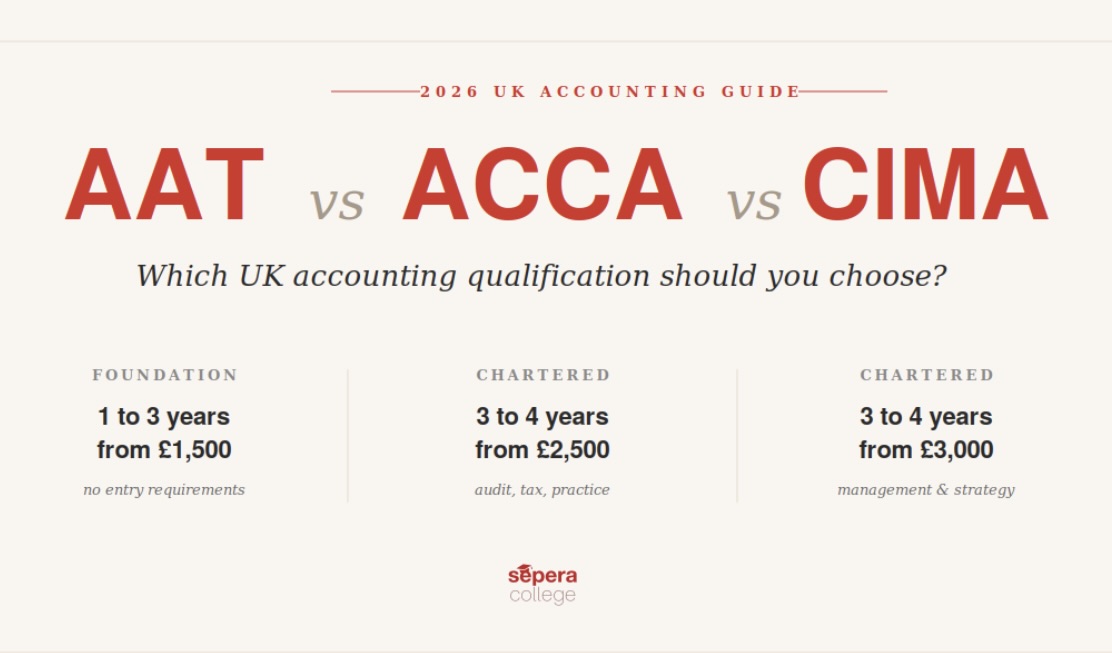
Quick Comparison: AAT vs ACCA vs CIMA at a Glance
Before we go deep, here’s how the three qualifications compare side by side.
| Feature | AAT | ACCA | CIMA |
|---|---|---|---|
| Full name | Association of Accounting Technicians | Association of Chartered Certified Accountants | Chartered Institute of Management Accountants |
| Level | Foundation to advanced (Levels 1 to 4) | Chartered (professional) | Chartered (professional) |
| Entry requirements | None | A-levels or equivalent | None at certificate level |
| Time to complete | 1 to 3 years | 3 to 4 years | 3 to 4 years |
| Typical cost | £1,500 to £3,500 | £2,500 to £4,500+ | £3,000 to £5,000+ |
| Career focus | Practical accounting and bookkeeping | Financial accounting, audit, tax | Management accounting, strategy |
| Best for | Beginners and career changers | Public practice, audit, finance | Industry, business strategy |
What is AAT?
AAT stands for the Association of Accounting Technicians, the UK’s leading professional body for accounting technicians. The AAT qualification is widely recognised by employers across the UK and is the standard entry route into a career in accounting.
The AAT qualification is structured across four levels:
- AAT Level 1: introduction to bookkeeping and basic accounting
- AAT Level 2: Certificate in Accounting or Bookkeeping
- AAT Level 3: Diploma in Accounting or Certificate in Bookkeeping
- AAT Level 4: Diploma in Professional Accounting, the highest AAT level
You can start AAT with no prior qualifications. There are no GCSE or A-level requirements, which makes it ideal for school leavers, career changers, and people returning to work after a break.
After completing AAT Level 4, you become eligible for full AAT membership (MAAT) and can use those letters after your name. Many AAT-qualified accountants go on to become licensed members, allowing them to work in practice and offer services directly to clients.
What is ACCA?
ACCA stands for the Association of Chartered Certified Accountants. It’s a global qualification recognised in over 180 countries and is one of the most respected chartered accounting qualifications in the world.
ACCA is significantly more advanced than AAT. It’s a chartered-level qualification, which means it’s typically taken by people who already have some accounting knowledge, an accounting degree, or have completed AAT.
ACCA covers areas including financial reporting, audit and assurance, taxation, strategic business reporting, and advanced financial management. After completing ACCA and meeting the practical experience requirements, you become a Chartered Certified Accountant.
ACCA-qualified accountants often work in public practice, audit firms, and large corporate finance functions. To start ACCA you’ll usually need at least 2 A-levels and 3 GCSEs in 5 separate subjects (including English and Maths). However, if you complete AAT Level 4 first, you receive significant exemptions from the early ACCA exams.
What is CIMA?
CIMA stands for the Chartered Institute of Management Accountants. Unlike ACCA, which focuses on financial accounting, audit, and tax, CIMA specialises in management accounting and business strategy.
CIMA is the qualification of choice for accountants who want to work inside businesses, rather than in accountancy practice. CIMA-qualified accountants typically work in roles like:
- Management accountant
- Finance business partner
- Financial analyst
- Finance director
- Chief financial officer (CFO)
The CIMA qualification is structured across four levels: Certificate, Operational, Management, and Strategic. You can enter CIMA at the Certificate level with no prior qualifications, but many students start at the Operational level after completing AAT or a relevant degree.
CIMA places heavy emphasis on strategy, decision-making, and using financial data to drive business performance. If you see yourself in a boardroom rather than an audit room, CIMA may be a better fit than ACCA.
AAT vs ACCA: The Key Differences
The biggest difference between AAT vs ACCA is the level of the qualification. AAT is a foundation to advanced practical qualification. ACCA is a chartered-level professional qualification.
Here’s how they compare in practice:
- Entry level: AAT requires no prior qualifications. ACCA typically requires A-levels or completion of AAT Level 4.
- Cost: AAT is significantly cheaper, typically £1,500 to £3,500 for the full qualification. ACCA usually costs £2,500 to £4,500 or more.
- Time: AAT can be completed in 12 to 36 months. ACCA typically takes 3 to 4 years.
- Career outcomes: AAT prepares you for roles such as bookkeeper, accounts assistant, finance officer, and AAT-licensed accountant. ACCA prepares you for chartered roles in audit, tax, and financial reporting.
- Recognition: Both are highly respected. AAT is the standard UK qualification for accounting technicians. ACCA is globally recognised across 180+ countries.
- Practical orientation: AAT is hands-on and practical from day one. ACCA leans more theoretical, particularly in the later strategic papers.
For most people starting out, the best route is AAT first, then ACCA. Doing AAT Level 4 first earns you up to three ACCA exam exemptions, saving both time and money.
AAT vs CIMA: The Key Differences
The key difference between AAT vs CIMA is focus. AAT covers the full breadth of accounting, including financial accounting, bookkeeping, tax, and costing. CIMA focuses specifically on management accounting and business decision-making.
If your goal is to work in industry (inside a company, supporting business decisions), CIMA may be the right destination. But for most beginners, AAT remains the smart starting point.
Why? Because AAT teaches you the foundations of accounting that CIMA assumes you already understand. Going straight into CIMA without that base can be very challenging if you have no accounting background.
Once AAT Level 4 is complete, you can move into CIMA at the Operational level with exemptions from the Certificate level. This saves you a full year of study.
Why AAT Is the Best Place to Start (Even If You Want to Become a Chartered Accountant)
Here’s the truth that doesn’t get said often enough: AAT is not a dead end. It’s a foundation.
The vast majority of UK accountants who eventually qualify as ACCA, CIMA, or ICAEW members start with AAT. Why? Because AAT teaches you:
- The fundamentals of double-entry bookkeeping
- How to prepare financial statements
- How to manage VAT and tax basics
- How to use real accounting software like Sage, Xero, and QuickBooks
- The practical skills that employers actually pay for
By the time you finish AAT Level 4, you’ll have everything you need to either work as a qualified accounting technician or progress into a chartered qualification with significant exemptions.
Starting with AAT also means you can earn while you learn. AAT-qualified accounting technicians typically earn between £22,000 and £35,000 a year in the UK, with senior roles paying more. That income can fund your further studies if you choose to progress.
How Much Does Each Qualification Cost in 2026?
Here’s a realistic breakdown of what each qualification costs this year.
AAT (Levels 2 to 4):
- Tuition: £1,200 to £3,000
- Exam fees: £400 to £600
- Books and resources: £150 to £300
- Total: £1,500 to £3,500
ACCA (full qualification):
- Tuition: £2,000 to £4,000
- Exam fees: £1,400 to £1,800
- Annual subscription: £125+
- Total: £2,500 to £4,500+
CIMA (full qualification):
- Tuition: £2,500 to £4,500
- Exam fees: £1,500 to £2,000
- Annual subscription: £130+
- Total: £3,000 to £5,000+
If you’re funding your studies yourself, AAT offers the best value entry point. At Sepera College, we also offer AAT courses funded by government grants for those on Universal Credit or Job Seeker’s Allowance, plus flexible payment plans through Klarna.
How Long Does Each Qualification Take?
Time commitment varies significantly between the three qualifications.
AAT typically takes 12 to 36 months depending on level and study mode. Most students complete Level 2 in 3 to 6 months, Level 3 in 6 to 12 months, and Level 4 in 9 to 15 months.
ACCA usually takes 3 to 4 years on average, longer if studying part-time. The 13 exams take time to work through, and most candidates take 1 to 2 papers per session.
CIMA takes 3 to 4 years on average. The exam structure is similar to ACCA with multiple levels to complete.
If you’re combining qualifications (for example AAT then ACCA), expect the full journey to take 4 to 6 years total. This is still a common route because the AAT foundation makes the later ACCA exams more manageable.
Which Qualification Should You Choose?
The right answer depends on your background and career goal.
Start with AAT if you’re:
- New to accounting with no prior experience
- A career changer looking for practical, employable skills
- Seeking a flexible, affordable entry into the profession
- Returning to work after a career break
- Targeting roles like bookkeeper, accounts assistant, or licensed accounting technician
Move on to ACCA if you want to:
- Work in public practice or audit firms
- Become a Chartered Certified Accountant
- Specialise in financial reporting, tax, or assurance
- Work internationally
Move on to CIMA if you want to:
- Work in industry (inside a business rather than a practice)
- Focus on management accounting and strategy
- Progress into finance leadership roles like CFO or finance director
For most beginners, the smartest path is AAT Level 2, then Level 3, then Level 4, then ACCA or CIMA with exemptions. This route gives you employable skills early, real-world income while you study, and a clear progression to chartered status if that’s where you want to go.
Frequently Asked Questions
Is AAT easier than ACCA?
Yes, AAT is generally considered easier than ACCA. AAT is a foundation to advanced qualification, while ACCA is a chartered-level qualification with significantly more complex content, particularly at the strategic level.
Can I do ACCA without AAT?
Yes, you can start ACCA without AAT if you have the required entry qualifications (typically A-levels). However, starting with AAT gives you a stronger foundation and earns you ACCA exam exemptions.
Is AAT worth it in 2026?
Yes. AAT remains the most recognised UK accounting technician qualification, and demand for qualified accounting technicians continues to grow. AAT also offers exemptions into ACCA, CIMA, and ICAEW.
Can I become a chartered accountant with just AAT?
No. AAT is not a chartered qualification. To become a chartered accountant, you’ll need to progress to ACCA, CIMA, ICAEW, or another chartered body after AAT.
Which pays more: AAT, ACCA, or CIMA?
ACCA and CIMA-qualified accountants typically earn more than AAT-qualified accountants, with salaries ranging from £45,000 to £100,000+ at senior levels. AAT-qualified accountants typically earn £22,000 to £40,000. However, AAT gets you earning much sooner.
How long does AAT take compared to ACCA?
AAT can be completed in 1 to 3 years. ACCA typically takes 3 to 4 years. Combining both (AAT then ACCA) usually takes 4 to 6 years.
Are AAT exemptions automatic for ACCA?
AAT exemptions for ACCA are not automatic but they are widely available. AAT Level 4 graduates can receive up to three exemptions from the ACCA Applied Knowledge papers.
Ready to Start Your Accounting Journey?
Choosing the right qualification is the first step. Starting it is the next.
At Sepera College, we’re an AAT-approved training provider offering AAT Bookkeeping and AAT Accounting courses across all levels (Level 1 to Level 4). Our students study via flexible webinars, online courses, and classroom sessions in London and Manchester.
If you’d like to talk through your options before you commit, we offer free trial lessons and free consultations.
Take the next step today:
- Book a free trial lesson
- Book a free consultation
- Browse our AAT courses
Get in touch with Sepera College today and find out which AAT course is right for you.